
Reviewed · WALKING TOURS
Amsterdam: World War II Private Walking Tour
WWII Amsterdam gets personal on this walk. This private 3-hour experience centers on the Monument to Jewish Resistance and other key Nazi-occupation sites, keeping the focus on what happened in Amsterdam from 1940 to 1945. You get history that’s grounded in place, not slides, and it’s designed for small-group attention.
Two things I like a lot: first, the private format means it’s restricted to your own group, so you can ask questions without crowd noise. Second, you’re guided by Ben de Jong and Peter Schaapman, and the storytelling style they’re known for fits this subject well, especially if you want street-level clarity about what life and persecution looked like under Nazi control.
One consideration before you book: this tour does not include the Anne Frank House, the Resistance Museum, or the Hollandsche Schouwburg deportation center, and coffee/tea is not included. So it’s a focused walk for context and understanding, not a ticket package to every major related museum.
In This Review
- Key highlights at a glance
- Where this tour starts: Prinsengracht to the heart of occupation history
- The main stop: understanding the Monument to Jewish Resistance
- The route between monuments: how a 3-hour walk stays manageable
- What you don’t get: the smart limits of the itinerary
- Guides Ben de Jong and Peter Schaapman: why the tone matters
- Price and value: what $180.04 per group really buys
- Who should book this tour (and who might skip it)
- Practical details that affect your day
- Should you book Amsterdam: World War II Private Walking Tour?
- FAQ
- How long is the Amsterdam World War II Private Walking Tour?
- Where does the tour start?
- Where does the tour end?
- What time does the tour start?
- Is this a private tour?
- How many people can be in a group?
- What’s included in the price?
- Does the tour include the Anne Frank House or other museums?
- What languages are offered?
- What is the minimum age recommendation?
- What’s the cancellation policy?
Key highlights at a glance
- Private group only (up to 4 people per group), so the pace and questions can stay yours
- Ben de Jong and Peter Schaapman guide you in English (and the experience is also offered in German)
- Jewish Resistance monument focus with other important occupation-era sites in Amsterdam
- On-foot route with a coffee/rest break halfway through
- Minimum age 13 and content that’s heavy but meaningful, with education-first framing
- Admission ticket free, though drinks and other museums’ tickets are not included
More of Amsterdam street by street, on foot
- Amsterdam Anne Frank: Small-Group Walking Tour & Local Guide
★ 4.8 · 12,789 reviews - Anne Frank’s Story – Guided Walking Tour through Amsterdam
★ 5.0 · 11,619 reviews - Absolutely Amsterdam – the Essential Introductory Walking Tour
★ 5.0 · 3,629 reviews - Amsterdam: Anne Frank Guided Walking Tour in DE/EN/IT/ES
★ 4.9 · 3,107 reviews
Where this tour starts: Prinsengracht to the heart of occupation history
The tour begins at Prinsengracht 263 (1016 GV), right in the canal-belt area. If you know Amsterdam, you’ll recognize this part of town as easy to reach and simple to orient from. That matters because your brain is going to be doing a lot during the walk. You’re not just seeing landmarks; you’re building a map of where events unfolded and how the city functioned under occupation.
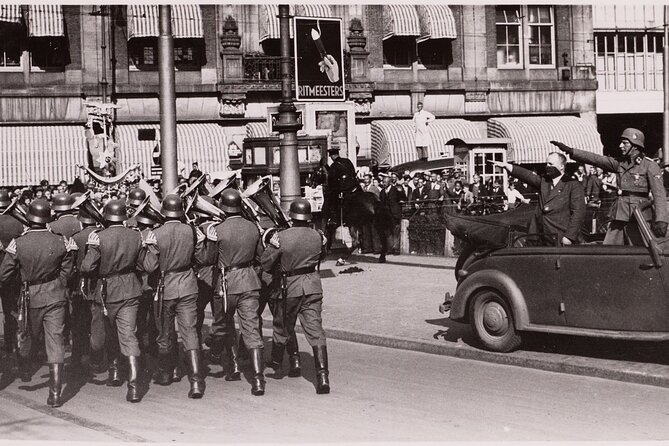
From the start, the tone is clear: this is history with weight. The experience is set around the Nazi occupation of Amsterdam between 1940 and 1945, and it aims to connect those events to the ongoing legacy of WWII. That phrasing isn’t just marketing. It’s the difference between a tour that lists dates and a tour that explains why these places still matter now.
I also appreciate that it’s offered in English and German. If you’re traveling as a multilingual group, or you want the option to choose whichever language feels most comfortable, that flexibility helps. And since confirmation is received at booking time and you’ll use a mobile ticket, you can keep things smooth without last-minute paper hunting.
Finally, the tour has a practical physical fitness note: you should have moderate physical fitness. For most people, that means you’ll be walking for about three hours at a steady pace. It’s not described as a strenuous hike, but it’s also not a slow museum crawl.
The main stop: understanding the Monument to Jewish Resistance
The centerpiece of this walk is the Monument to Jewish Resistance. That’s a big deal, because the name signals the subject focus: Jewish resistance during the Nazi occupation, not only the broader occupation story or the most famous individual narratives.
Here’s what makes this approach valuable. Amsterdam has lots of WWII-related markers, but not all of them explain the same thing. By centering on Jewish resistance, the tour naturally shifts your attention toward organized courage, survival under extreme pressure, and the reality that resistance took many forms. It also supports a fuller understanding of what the Nazi occupation meant in daily life, beyond headlines.
The walk is described as ideal if you want to go off the beaten path. That’s exactly what you should look for with WWII tours. The “classic tourist loop” often compresses everything into one or two big stops. This experience is built to take you through lanes and streets that you likely wouldn’t notice on your own, which helps the story feel anchored.
Another detail worth noting: you won’t be doing this as a museum-style lecture. The format is a guided walking experience where you informally “read” the city as you go. That works especially well for heavy history, because context lands better when it’s tied to the physical environment.
One more practical point: content is the reason for the minimum age of 13. If you’re traveling with teens or older kids who can handle serious topics and have curiosity about history, this age guidance is a helpful signal that the tour is framed thoughtfully for that range. If you’re traveling with younger children, you’ll likely want something lighter or a different route.
The route between monuments: how a 3-hour walk stays manageable
The duration is about 2.5 to 3 hours, and there’s a short break about halfway through for a coffee and/or a restroom visit. That’s the kind of planning detail that makes a big difference on a walking tour, especially one dealing with difficult subject matter. You get a mental reset without losing momentum.
The tour also ends at the National Holocaust Names Monument (1018 DP Amsterdam). Even though the tour’s main scheduled stop is the Monument to Jewish Resistance, ending here reinforces the theme: remembrance and the long shadow of WWII in how Europe thinks about names, loss, and accountability. Ending at a remembrance site rather than backtracking to the original start point helps the walk feel like a complete arc.
Timing matters too. The start time is 9:30 am. An early start can help you avoid the densest foot-traffic periods. It also gives you more of the day left afterward for a museum visit you choose on your own. For example, since this tour doesn’t include the Anne Frank House or other specific museums, starting in the morning is a smart way to keep your options open later.
You’ll also want to dress for Amsterdam walking. The tour doesn’t promise indoor time, and with city walking routes, weather can change your comfort quickly. Even if you can handle a moderate walk, shoes and layers are what keep the experience enjoyable rather than tiring.
More private tours with a guide to yourself




What you don’t get: the smart limits of the itinerary
This is where you should set expectations clearly. The tour does not include visits to:
- Anne Frank House
- Resistance Museum
- Hollandsche Schouwburg (the deportation center)
Also, coffee/tea is not included.
That might sound like a drawback at first, but for the right traveler it’s actually a good design choice. A walking tour focused on Nazi occupation sites needs room to cover meaning, context, and explanation. If it tried to stuff in major museum tickets too, the experience would either get rushed or turn into a checklist of rooms. Instead, you get a guided route that prioritizes interpretation and place-based understanding.
So think of this as a “foundation walk.” It’s ideal if you want the background that helps other WWII sites make more sense. If your goal is to spend half a day inside a museum and you’re only interested in that kind of format, you may find a walking tour less satisfying. But if you want context you can connect to whatever you choose next, this is a strong fit.
Also keep this in mind: admission ticket is listed as free, which typically helps simplify what you need to pay during the tour itself. The museums that are not visited here would be separate decisions for you.
Guides Ben de Jong and Peter Schaapman: why the tone matters
You’re guided by Ben de Jong and Peter Schaapman. In tours about WWII, the guide’s approach matters more than most people expect. This kind of history can easily turn into either dry recitation or emotional overwhelm. The best versions land in the middle: factual, human, and anchored in what you’re standing in front of.
The feedback connected to this experience highlights Peter Schaapman especially for clear, detailed street-level explanation, including what Amsterdam looked and felt like under Nazi control. It’s also described as an experience where you learn through lanes and alleyways you’d probably never find on your own, while still standing in places tied to tragic events.
Even if you’re someone who thinks you already know Amsterdam WWII facts, you’ll often be surprised by how the city’s layout and specific corners shape the story. A good guide uses that reality, and that’s exactly what this format is built for.
Language support also matters. English is offered, and German is an option too. If you’re traveling with someone who prefers one language over another, you can often make the experience feel more personal simply by choosing the language that lets you follow every nuance.
Price and value: what $180.04 per group really buys
The price is $180.04 per group, for up to 4 people. That setup changes the math. For one person, it’s expensive compared with public-group tours. For a small group of friends or a family of four, it can work out much better because you’re paying for privacy and for two major benefits at once: guided interpretation and restricted group access.
Here’s what you get that supports the value:
- Private group format (your group only)
- A focused 2.5–3 hour guided route
- Admission ticket is free as part of the experience
- A planned break halfway through
And here’s what you should plan to pay separately:
- Coffee/tea (not included)
- Any museums not visited on this walk, if you add them later
To decide if it’s worth it for you, ask a simple question: do you want a calmer, more ask-anything experience, or do you want the cheapest possible way to cover WWII sites? If you want deeper guidance in a quieter setting, the price makes sense. If you’re price-sensitive and don’t mind sharing your guide’s attention, a larger-group tour might be a better fit.
One more practical thought: the tour is booked on average 54 days in advance. That’s usually a sign it’s in demand. If your dates are fixed, I’d rather you book early than wait.
Who should book this tour (and who might skip it)
This tour is best for you if:
- you like history that’s tied to specific places
- you want the Nazi occupation story with an emphasis on Jewish resistance
- your group is small enough to benefit from privacy
- you prefer walking tours that explain more than they just point
It’s also a great choice for visitors who want to go off the main “tourist rail” and see Amsterdam through a more serious lens. The structure feels designed for people who care about context, not just photos.
You might consider skipping (or pairing differently) if:
- your main goal is Anne Frank House, the Resistance Museum, or the deportation center visits
- you don’t want topics connected to persecution and occupation
- you’re looking for a light or entertainment-style walking tour
Because the suggested minimum age is 13, this also tends to work best for teens and adults who can engage with heavy history thoughtfully.
Practical details that affect your day
The tour runs about three hours, starts at 9:30 am, and uses a mobile ticket. It’s near public transportation, which is useful in Amsterdam when you’re mixing canal walks with transit. Service animals are allowed, which is a good note if you rely on one.
Since this is a walking experience, plan around footwear and weather. Amsterdam’s weather can be unpredictable, and you’ll feel it more on a route than if you’re hopping between indoor museums.
You’ll also want to know the tour content is serious. That doesn’t mean it’s gloomy for the sake of it. It means your guide will be dealing with traumatic events in a guided, educational way. If you’re someone who prefers historical context before visiting major sites later, this walk can help you make sense of what you see next.
Should you book Amsterdam: World War II Private Walking Tour?
Book it if you want a private, place-based WWII experience in Amsterdam that focuses on Jewish resistance and the Nazi occupation period. You’ll likely appreciate the attention to streets and corners you’d miss on your own, plus the fact that it’s paced like a real walk with a halfway break.
Skip it if you mainly want a menu of major museum stops like the Anne Frank House or the Resistance Museum. This tour is a foundation and a focus, not an all-in-one museum day.
If you’re planning your WWII route thoughtfully—doing this walk first to build context, then choosing any museums you personally want next—this is the kind of guided experience that makes the rest of your day hit harder in a good way.
FAQ
How long is the Amsterdam World War II Private Walking Tour?
It lasts about 3 hours (approximately 2.5 to 3 hours).
Where does the tour start?
The tour starts at Prinsengracht 263, 1016 GV Amsterdam.
Where does the tour end?
The tour ends at the National Holocaust Names Monument, 1018 DP Amsterdam.
What time does the tour start?
The start time listed is 9:30 am.
Is this a private tour?
Yes. It’s private and restricted to your own group.
How many people can be in a group?
Pricing is per group for up to 4 people.
What’s included in the price?
All fees and taxes are included, and the admission ticket is listed as free. Coffee and/or tea are not included.
Does the tour include the Anne Frank House or other museums?
No. The tour does not visit the Anne Frank House, the Resistance Museum, or Hollandsche Schouwburg. Tickets for those places are not included.
What languages are offered?
The experience is offered in English and German.
What is the minimum age recommendation?
The suggested minimum age is 13.
What’s the cancellation policy?
You can cancel for a full refund up to 24 hours before the experience start time. If you cancel less than 24 hours before, the amount paid is not refunded.
More Amsterdam Walking Routes






More Tours in Amsterdam




More Tour Reviews in Amsterdam






Just added: fresh Amsterdam tour reviews





Walking Tours, compared.
 ★ 4.8Amsterdam Anne Frank: Small-Group Walking Tour & Local GuideFrom $2912,789 reviews
 ★ 5.0Anne Frank’s Story – Guided Walking Tour through AmsterdamFrom $3911,619 reviews
 ★ 5.0Absolutely Amsterdam – the Essential Introductory Walking TourFrom $53,629 reviews
 ★ 4.9Anne Frank Guided Walking Tour in DE/EN/IT/ESFrom $283,107 reviews
 ★ 4.8Anne Frank Guided Small Group Walking TourFrom $282,722 reviews
 ★ 4.9Cultural Highlights Walking TourFrom $302,629 reviews
 ★ 4.2Ganja Walking TourFrom $402,127 reviews
 ★ 5.0Anne Frank Walking Tour Amsterdam Including Jewish Cultural QuarterFrom $751,879 reviews
Browse the lists this tour appears in