

Reviewed · WALKING TOURS
Amsterdam Walking Tour with Audioguide on Your Smartphone
Your phone becomes the tour buddy you wish you had. This Amsterdam walk is self-guided with an audio guide that uses offline GPS, so you can wander at your own speed. You follow a set route through major landmarks and some quieter corners, with prompts timed for an easy stroll.
I like the way the app is narrated by a professional historian and pairs stories with illustrations, so you can spot each place fast. I also like the control: you can pause, rewind, or linger when a building, canal view, or odd detail grabs your attention.
One thing to plan around: you bring your own smartphone and headphones, and museum entry tickets are not included. That’s not a deal-breaker, but you should expect to pay extra if you want inside stops.
In This Review
- Key Things You’ll Appreciate on This Amsterdam Audio Walk
- Why a Smartphone Audioguide Works So Well in Amsterdam
- What You Need to Bring (And What You Don’t)
- Getting Started at Amsterdam Centraal: Old Harbor to Train Station
- The Weeping Tower Stop That Plays With Your Expectations
- Houten Huys: Amsterdam’s Old Timber House in the Red Light District
- Ons’ Lieve Heer op Solder: A Hidden Catholic Church Story
- Oude Kerk to Waag: Where Faith, Healing, and Science Intersect
- De Wallen and Dam Square: A Quick Route Through Big Contrasts
- Wax Figures and Neo-Gothic Views: Tussauds and De Papegaai
- Beguinage Courtyard to Lieverdje Statue: Small Stories With Social Teeth
- Singel Canal and Bloemenmarkt: Follow Water to Find Color
- Munt Tower and the Cinema Corner: Views and Art Deco Energy
- Rembrandtplein, Stadsarchief, and the Reality Check of Museums
- Museum Quarter Time: When Your Walk Becomes a Museum Plan
- Value for Money: Is $8.37 a Good Deal?
- Who This Tour Fits Best (And Who Should Skip It)
- Should You Book This Amsterdam Smartphone Walking Tour?
- FAQ
- How long is the Amsterdam walking tour?
- Is this tour guided by a person?
- Do I need internet for the route?
- Do museum tickets cost extra?
- Where do I start the walk?
- What devices does the audio guide work on?
- How long do I have access to the audio guide after purchase?
Key Things You’ll Appreciate on This Amsterdam Audio Walk

- Offline GPS map so you can keep moving even if your connection acts up
- 31 historian audio recordings with clear landmark cues and illustrations
- No group pressure: pause, rewind, and set your own pace
- A mix of big sights and smaller backstories beyond just the obvious postcard stops
- One-year access to replay in your chosen language after you buy
- Budget-friendly pricing compared with many guided tours
More of Amsterdam street by street, on foot
- Amsterdam Anne Frank: Small-Group Walking Tour & Local Guide
★ 4.8 · 12,789 reviews - Anne Frank’s Story – Guided Walking Tour through Amsterdam
★ 5.0 · 11,619 reviews - Absolutely Amsterdam – the Essential Introductory Walking Tour
★ 5.0 · 3,629 reviews - Amsterdam: Anne Frank Guided Walking Tour in DE/EN/IT/ES
★ 4.9 · 3,107 reviews
Why a Smartphone Audioguide Works So Well in Amsterdam
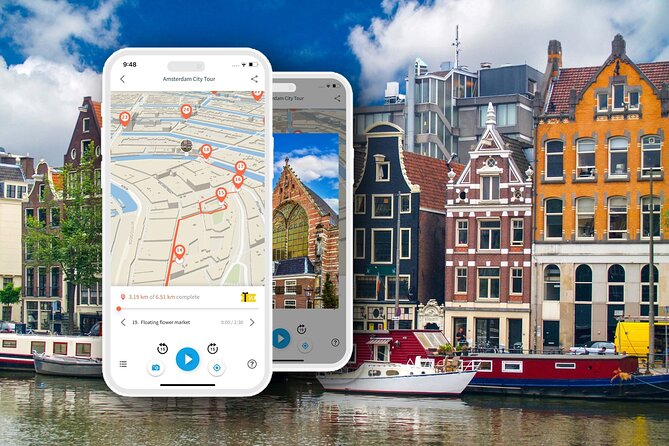
Amsterdam rewards slow walking. Streets are compact, canals create natural paths, and surprises pop up every few minutes. A self-paced audio route fits that rhythm perfectly because you do not need to match anyone else’s pace.
This tour uses your phone for GPS navigation and guides you through 31 key stops. The audio is narrated by a professional historian, which matters, because you are not just listening to facts. You’re getting stories that connect buildings, trade, religion, and daily life into one walk you can actually follow.
I also like that the app is designed for attention. You get illustrations to recognize landmarks, so you spend less time playing Where is it? and more time looking at what’s in front of you.
What You Need to Bring (And What You Don’t)
Before you start, check your setup. You will need a smartphone (iPhone or Android) and the ability to listen through your headphones.
Here’s what the experience includes:
- An audio guide app for iPhone and Android
- An offline map with the route and GPS navigation
- 31 audio recordings narrated by a professional historian
- Illustrations to recognize each landmark
- One-year access in your preferred language
Here’s what’s not included:
- An in-person guide
- Smartphones and headphones
- Entry tickets for museums and attractions
- Transportation, food, and drinks
So think of it like this: you’re paying for the walking plan plus the stories. If you want to go inside places like major museums, you’ll need to buy those tickets separately.
Getting Started at Amsterdam Centraal: Old Harbor to Train Station
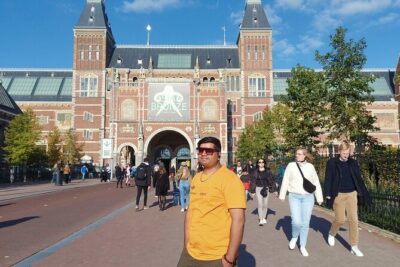
You start at Amsterdam Centraal (Stationsplein, 1012 AB Amsterdam). The first stop is your chance to reset your bearings. You get a story about what used to be there and how the station came to be on the site of a former harbor.
This matters more than it sounds. Amsterdam’s center feels timeless, but the city has constantly re-shaped itself around water and trade. Beginning with the station sets the tone: you’re walking through layers.
The stop is short (about 10 minutes), which is perfect for getting your phone app synced, your audio volume comfortable, and your route ready to go.
Still deciding? A few more Amsterdam tours worth a look





The Weeping Tower Stop That Plays With Your Expectations
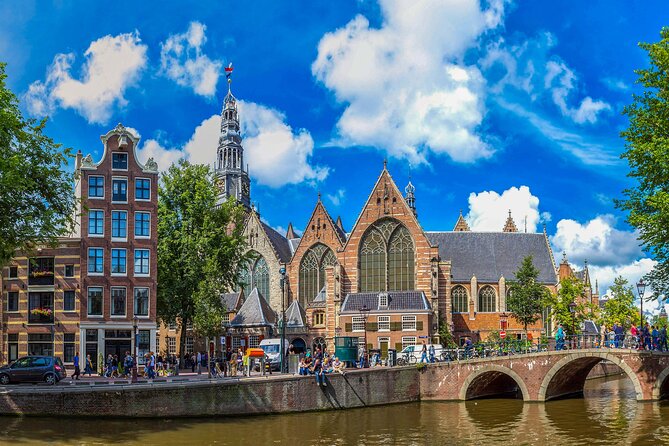
Next up is the Weeping Tower. You’ll hear why the famous crying tower of Amsterdam does not cry at all, plus history tied to the East India Trading Company.
This is the kind of stop that works well with audio. If you just pass by, you might miss the story behind the name. With a guided script in your ear, you notice the building details more, because you know what you’re looking for.
It’s another about 10 minutes, so you keep momentum without feeling rushed.
Houten Huys: Amsterdam’s Old Timber House in the Red Light District
Then you reach Houten Huys (Wooden House), described as Amsterdam’s oldest surviving house, built around 1425. It sits at the heart of the Red Light District, and the audio explains its medieval past and what that means for the neighborhood around it.
This stop is useful because it prevents a one-note visit. The Red Light District is often reduced to neon and headlines, but a place can be complicated and still worth seeing thoughtfully. The audio nudges you to connect the area’s older layers to what you see today.
It’s also a quick stop (around 10 minutes), which helps keep the walk smooth.
Ons’ Lieve Heer op Solder: A Hidden Catholic Church Story
One of the most intriguing points on the route is Museum Ons’ Lieve Heer op Solder, set in a 17th-century canal house. The audio guide’s description focuses on a hidden Catholic church preserved in the attic, framed as an act of defiance.
Audio shines here because the point is context. You’re not only looking at architecture; you’re learning why that architecture had to be hidden. Even if you do not buy entry tickets, the story helps you interpret what you’re seeing outside.
If you do want to go inside, you’ll need separate admission. Still, the walk’s timing (short and story-first) helps you decide without feeling pressured.
Oude Kerk to Waag: Where Faith, Healing, and Science Intersect

After the canal-house story, the route takes you past Oude Kerk (Old Church). The audio covers how a miraculous healing story helped transform Amsterdam into a pilgrimage destination.
Then comes The Waag (Weigh House), tied to anatomical theaters and even why Rembrandt visited. The audio gives you a reason to look beyond the facade and think about the city’s interest in observation and study.
These are two different flavors of Amsterdam: spiritual pull at one church, and a more scientific/artistic angle at the Waag. The audio guide helps you hold both ideas in your head at once, instead of bouncing from one random landmark to the next.
Each of these segments is kept to roughly 10 minutes, which is ideal for short attention loops without killing your walking day.
De Wallen and Dam Square: A Quick Route Through Big Contrasts

You then spend time in De Wallen (Red Light District). The audio frames it as more than the stereotypes: it’s described as a complex blend of history, culture, and modern life, shaped by its port and trading role.
Next is Dam Square and Damstraat. At Dam Square, you’ll hear about the Royal Palace area and the New Church, and how the Netherlands evolved into a kingdom. You also get practical cues for what to notice as you walk around the square.
Right after that, the route highlights:
- Koninklijk Paleis (originally built in the 17th century as city hall, linked to Golden Age wealth and power)
- De Nieuwe Kerk (New Church) (15th-century Gothic church tied to royal ceremonies)
The value here is pacing. You see a lot of major landmarks, but you’re not expected to stop for long. Audio gives you enough grounding to recognize why these places matter.
One consideration: Dam Square can be busy, even for a self-guided route. If you’re sensitive to crowds, you might want to keep your stops shorter and let the audio carry you while you move.
Wax Figures and Neo-Gothic Views: Tussauds and De Papegaai
The route passes Madame Tussauds Amsterdam, placed right around Dam Square. Since entry tickets are not included, you’ll likely use this stop to decide rather than assume you’ll go in. Still, it’s a good landmark to orient yourself toward what’s near the center.
Then you reach H.H. Petrus en Pauluskerk (De Papegaai), a neo-Gothic church built in the 19th century, with a towering spire and detailed stonework. You’re guided to notice the architecture and what makes it special.
This section works because it breaks the heavy concentration of civic and commercial landmarks. Churches and historic architecture give your eyes a different job during the walk.
Beguinage Courtyard to Lieverdje Statue: Small Stories With Social Teeth
You’ll also hear about the Beguinage and how its inner courtyard connects to the emergence of early feminists in Europe. That’s a different kind of Amsterdam story than trade or kings, and it gives the walk social meaning.
Next is a quietly memorable stop: Statue Amsterdams Lieverdje near the edge of Vondelpark. The audio explains the working-class connection behind this small bronze figure of a boy.
I like these moments because they remind you that Amsterdam’s identity is not only built on famous artists and palaces. A city also defines itself through ordinary people and the symbols it chooses to keep.
Singel Canal and Bloemenmarkt: Follow Water to Find Color
At Singel (Singel Canal), you learn about Amsterdam’s oldest canal and the total count of canals, plus why the city developed such an extensive water network. Even if you have walked near canals before, having a number and a reason in your ear changes the way you see the city layout.
Then you reach Bloemenmarkt, the floating flower market along the Singel Canal. The audio explains it has been around since the 19th century, originally serving as a hub for flower trading.
This part is practical too. The floating market area gives you a clear visual target, which makes the audio route easier to navigate. And if you enjoy photos, this is one of the better photo windows because the boats and colors provide instant frames.
Munt Tower and the Cinema Corner: Views and Art Deco Energy
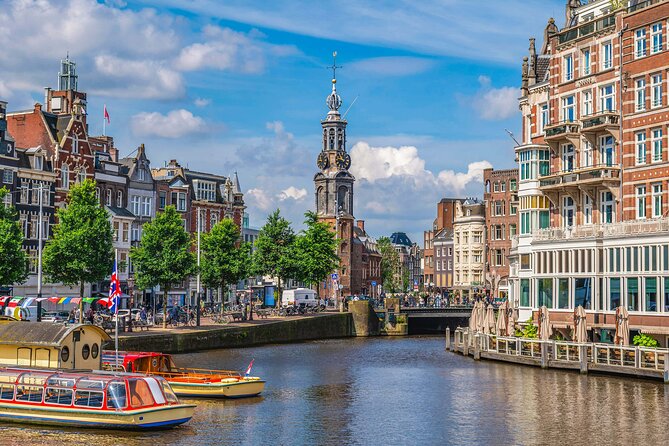
Next is Munt Tower (Munttoren), built in the 15th century as part of the old defensive walls. The audio helps you connect it to Amsterdam’s skyline and its older fortification logic.
Then you hit Pathe Tuschinski (Tuschinski Theater). This is an Art Deco building opened in 1921, tied to cinematic history. You get a sense of how the architecture played with style and spectacle.
This makes a nice shift from canals into city blocks. Towers and theaters are built for the eye, so even short audio stops feel rewarding.
Rembrandtplein, Stadsarchief, and the Reality Check of Museums
The route continues to Rembrandtplein, a lively square named after the painter. The audio highlights what anchors the square and why it’s tied to Rembrandt’s legacy.
Then comes Stadsarchief Amsterdam (City Archive), described as a modern building that houses millions of documents, photos, and maps. This is a reminder that Amsterdam’s story isn’t only in museums. It’s also in archives and records that preserve how the city changed.
After that, the walk points you toward some major attraction options:
- The Heineken Experience, located in the former brewery building
- Paradiso, a venue in a former church with dramatic architecture and stained-glass noted by the route description
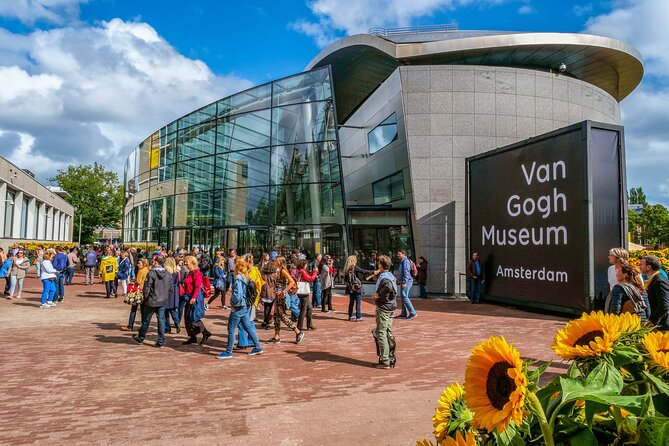
- The big museum neighborhood around Museumkwartier / Museumplein, including the Rijksmuseum, Diamant Museum, and Van Gogh Museum
Important note: the tour does not include museum tickets. So you’ll likely treat these as decision points. You can buy tickets if something really interests you, or you can just take the architecture and location in without spending extra money.
Museum Quarter Time: When Your Walk Becomes a Museum Plan
The audio route spends short time in Museum Quarter (Museumkwartier), emphasizing Museumplein as the cultural hub, surrounded by major museums. The audio’s approach is helpful because it gives you a basis to choose among them instead of getting overwhelmed by the options.
Here’s what the route calls out:
- Rijksmuseum: a major collection of Dutch art and history, with masterpieces by artists like Rembrandt and Vermeer, housed in a building designed by Pierre Cuypers
- Diamant Museum: a look at diamonds and why they matter in Amsterdam’s history
- Van Gogh Museum: dedicated to Vincent van Gogh, with the largest collection of his paintings
- Plus nearby attraction stops earlier in the walk that keep the day varied
If you want to turn the walk into a full itinerary, this is where you start picking your next ticket. The audio guide gives enough context for you to decide based on your interests.
And since the app gives you one-year access, you can always come back to the same route another day if you missed a stop or if you want to revisit with fresh eyes.
Value for Money: Is $8.37 a Good Deal?
At $8.37 per person, this is priced like a low-cost upgrade to your own wandering. You’re not paying for a human guide. You’re paying for a guided narrative with offline GPS and 31 recordings.
That can be great value if:
- You like history but do not want a long lecture
- You prefer to stop when you feel like it
- You want an easy way to connect the city’s landmarks into one story
- You’re traveling solo or as a small group and hate waiting for everyone
It’s less ideal if:
- You want someone to manage logistics for you
- You plan to spend most of the day inside museums and want tickets bundled
- You don’t like using your phone for navigation
The balance here is simple: for the price, you’re buying independence plus solid storytelling.
Who This Tour Fits Best (And Who Should Skip It)
This walk suits people who want control. If you like choosing your pace and enjoying side streets without a group schedule, you’ll enjoy the format. It also works well for couples who want a shared narrative but still want personal space.
It’s not the best match if you want a traditional guided tour with Q&A, or if you do not plan to bring headphones. It can also feel too short for people who want lots of deep museum time, since it’s built as a walking route with short stops.
One more practical detail: the route is capped at a maximum of 20 travelers, which suggests it’s a small-batch offering, even though it’s self-guided.
Should You Book This Amsterdam Smartphone Walking Tour?
I think this is a smart buy if you want to get your bearings and learn without feeling locked into a schedule. The standout features for me are the offline GPS, the professional historian audio, and the way the route mixes famous stops with less obvious backstories.
Book it if you:
- Want a budget-friendly way to understand Amsterdam fast
- Like short stops and flexible timing
- Plan to use the museum areas as decision points rather than guaranteed entry
Skip it if you:
- Want a live guide and group management
- Need tickets included for the major museums
- Don’t want phone navigation at all
If you fall in the first group, this walk can turn an ordinary stroll into a day with meaning, humor, and better sight-reading of the city around you.
FAQ
How long is the Amsterdam walking tour?
It takes about 2 hours 30 minutes (approx.).
Is this tour guided by a person?
No. It’s self-guided with an audio guide app. There is no in-person guide.
Do I need internet for the route?
You get an offline map with GPS navigation, so you can follow the route without relying on an always-on connection.
Do museum tickets cost extra?
Yes. Entry tickets to museums are not included and must be purchased separately in advance.
Where do I start the walk?
You start at Amsterdam Centraal, Stationsplein, 1012 AB Amsterdam, Netherlands.
What devices does the audio guide work on?
The audio guide app works on iPhone and Android.
How long do I have access to the audio guide after purchase?
You get one-year access to the tour in your preferred language.
More Amsterdam Walking Routes






More Tours in Amsterdam




More Tour Reviews in Amsterdam






Just added: fresh Amsterdam tour reviews





Walking Tours, compared.
 ★ 4.8Amsterdam Anne Frank: Small-Group Walking Tour & Local GuideFrom $2912,789 reviews
 ★ 5.0Anne Frank’s Story – Guided Walking Tour through AmsterdamFrom $3911,619 reviews
 ★ 5.0Absolutely Amsterdam – the Essential Introductory Walking TourFrom $53,629 reviews
 ★ 4.9Anne Frank Guided Walking Tour in DE/EN/IT/ESFrom $283,107 reviews
 ★ 4.8Anne Frank Guided Small Group Walking TourFrom $282,722 reviews
 ★ 4.9Cultural Highlights Walking TourFrom $302,629 reviews
 ★ 4.2Ganja Walking TourFrom $402,127 reviews
 ★ 5.0Anne Frank Walking Tour Amsterdam Including Jewish Cultural QuarterFrom $751,879 reviews
Browse the lists this tour appears in