
Reviewed · WALKING TOURS
Amsterdam: “Operation 45 ” Treasure Hunt Walking Tour
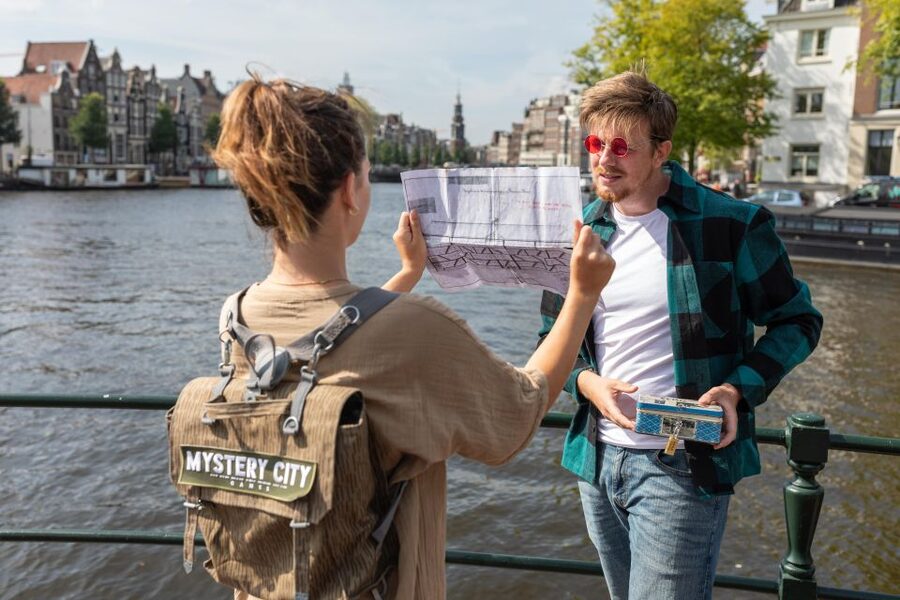
Diamonds, WWII, and street-level mystery in Amsterdam. What makes Operation 45 stand out is that you don’t just see landmarks—you work them, using a storyline tied to the Dutch Resistance. I like the fact that the clues are built around what’s already on the streets, so the city becomes your game board.
What I also really like is the physical backpack setup. This isn’t an app game where you stare at your phone. You solve with maps, boxes, and locks, and you earn a prize at the end. The main drawback to plan around: it can run closer to 2–3 hours depending on how quickly your group cracks the puzzles.
In This Review
- Key points to know before you go
- WWII diamonds and a treasure hunt you can actually feel on your feet
- You get history in motion, not history as a lecture
- Where it starts: Mystery City Games and your tin-and-map backpack
- What to bring (and what really matters)
- The old Jewish District route: wandering with a reason
- Shadow Wall and Portuguese Synagogue: the city teaches you to read clues
- Why these stops work for the puzzle
- Artis Zoo and the diamond-factory style stop
- How the puzzles work: architecture clues plus a kit of real objects
- Difficulty: fun for escape-room fans, slower for relaxed groups
- Timing and walking: 3 km, and a realistic finishing window
- Price value: $29 for a story-led, prop-based game
- Who this tour suits best (and who should reconsider)
- Age fit: minimum age matters
- Final take: should you book Operation 45?
- FAQ
- How long is the Operation 45 walking tour?
- How much does it cost?
- Is this an app-based game?
- Where do I meet the tour?
- What should I bring?
- Is it suitable for children or limited mobility?
Key points to know before you go
- WWII diamond-heist story with Dutch Resistance clues you follow across multiple stops
- Architecture-based puzzles that make you look closely at buildings and details
- Former Jewish District route that feels calmer than the usual tourist core
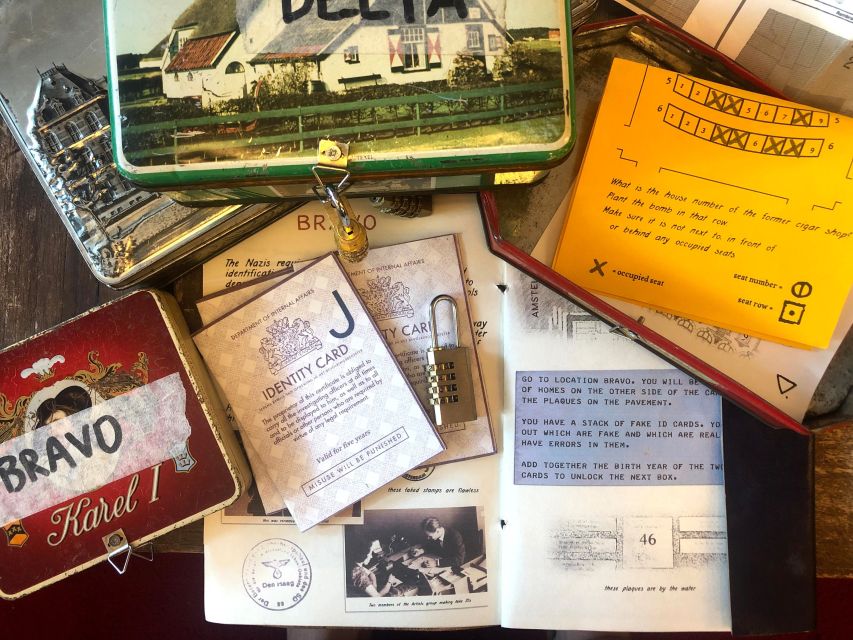
- Real game props (backpack with tins, maps, boxes, and locks), not a phone app
- 3 km walking route that many groups finish in about 2 hours
More of Amsterdam street by street, on foot
- Amsterdam Anne Frank: Small-Group Walking Tour & Local Guide
★ 4.8 · 12,789 reviews - Anne Frank’s Story – Guided Walking Tour through Amsterdam
★ 5.0 · 11,619 reviews - Absolutely Amsterdam – the Essential Introductory Walking Tour
★ 5.0 · 3,629 reviews - Amsterdam: Anne Frank Guided Walking Tour in DE/EN/IT/ES
★ 4.9 · 3,107 reviews
WWII diamonds and a treasure hunt you can actually feel on your feet
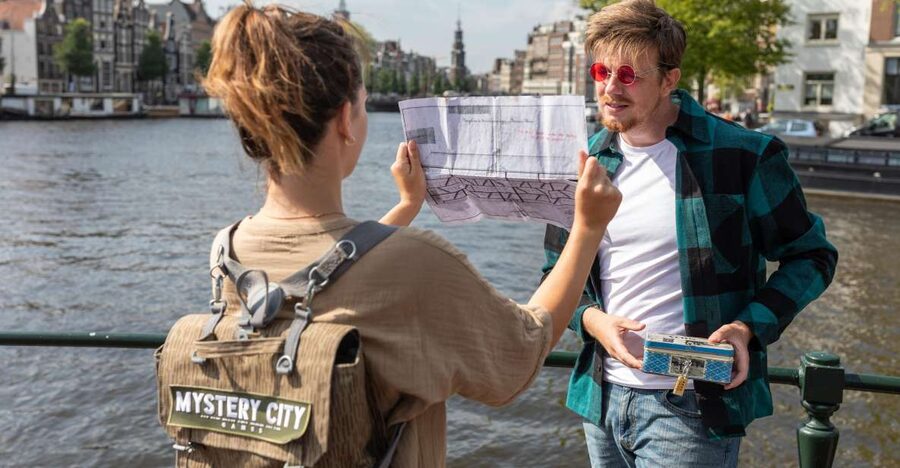
Operation 45 Treasure Hunt Walking Tour is built like an escape room that decided to take a long walk through Amsterdam. The premise is simple: at the start of WWII, a cache of diamonds goes missing in the city. From there, you play detective with the tools in your backpack, following a trail linked to the Dutch Resistance and moving through the old Jewish District.
This is the kind of activity that makes the city feel different fast. Instead of a checklist of sights, you get a reason to slow down. You’ll notice architectural details you’d usually glide past. And because the story threads through the route, every stop feels like another paragraph of the same narrative rather than a random scatter of photo ops.
You get history in motion, not history as a lecture
The experience isn’t trying to be a museum presentation. It’s structured so you keep walking while you learn. You’ll hear stories connected to the Dutch Resistance and the missing diamonds as you solve puzzle steps at key locations. That’s a smart way to make the past stick, especially if you learn better by doing instead of listening.
Just keep expectations realistic: you’re not speeding through Amsterdam. You’re solving, backtracking a little when a clue doesn’t click, and taking time to examine surfaces. If you’re the type who wants pure sightseeing with minimal interaction, this might feel too “game-like.” If you like puzzle work, it’s a great match.
Where it starts: Mystery City Games and your tin-and-map backpack
You meet at Mystery City Games, Zwanenburgwal 178, 1011 JH Amsterdam, and you’re looking for the Mystery City Games sign. This is the start point they call the secret headquarters, and it sets the tone immediately.
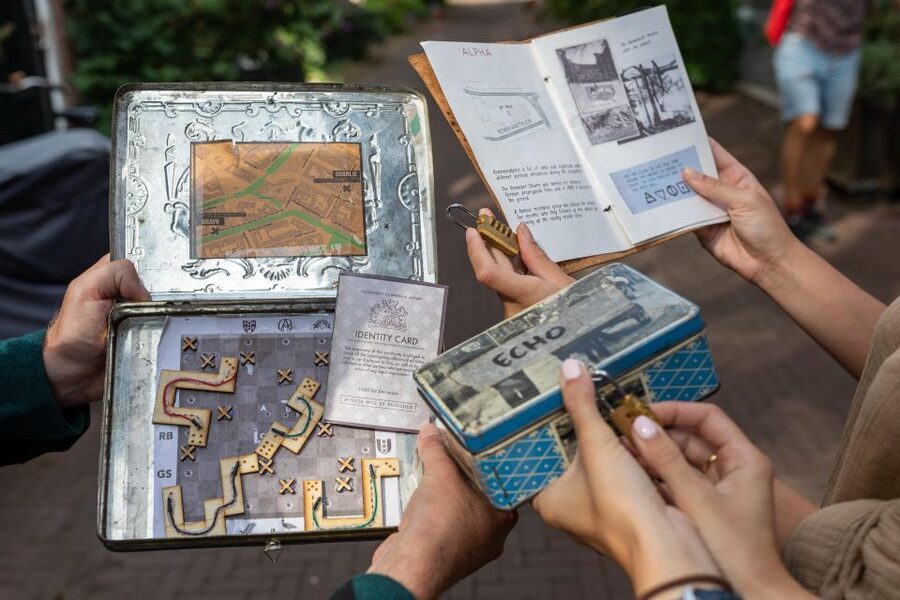
At the beginning, you’ll meet the Game Master, get pulled into the storyline, and collect a backpack loaded with game materials. The tour description is clear that this is not an app—your kit is meant to be used in real life. Expect treasure maps, boxes, locks, and older-style tools meant to fit the WWII theme.
That physical format matters more than it sounds. Paper clues and locked boxes force you to talk, collaborate, and test ideas. It’s also easier to stay focused because you’re not switching between screens, photos, and GPS. You’re simply following the next instruction and putting the pieces together.






What to bring (and what really matters)
Bring comfortable shoes. That’s not a generic line—your route is about 3 km, and the whole point is that you’re moving between puzzle points. If your feet aren’t happy, the game starts feeling like punishment instead of play.
The old Jewish District route: wandering with a reason
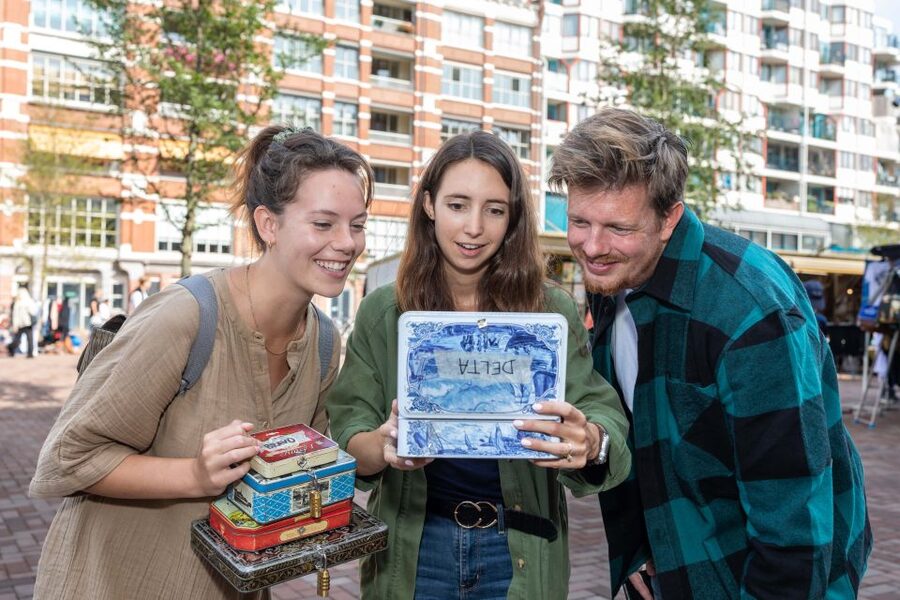
One of the best parts of Operation 45 is where it takes you. You’ll explore Amsterdam’s former Jewish District, and the tour is designed to go beyond the city’s most obvious tourist lanes. That matters for two reasons.
First, the tone of the story fits better in a neighborhood setting than in a sightseeing strip full of tour buses. Second, walking here gives you a different Amsterdam texture. You’re not only looking at famous sites; you’re looking at streets and buildings where you’d otherwise just pass by.
The route also has a “trail” feeling. You’re not zigzagging randomly. You’re following the next location in the diamond-heist narrative, and each stop has puzzle work that connects back to the story.
Shadow Wall and Portuguese Synagogue: the city teaches you to read clues
Among the named stops, Shadow Wall is one you’ll probably remember even if you’re not a hardcore history buff. The tour uses these locations as puzzle checkpoints, so you’re not just absorbing visuals—you’re actively looking for what the clue wants you to notice.
Then there’s the Portuguese Synagogue area. This stop is another place where architecture becomes information. The tour is built around the idea that clues are hidden in the city’s structure, and that means you’ll slow down and examine details instead of rushing for the best angle.
Why these stops work for the puzzle
Using real landmarks for puzzles does something clever: it prevents the game from feeling abstract. Instead of solving in a vacuum, you’re solving while standing somewhere that makes sense in the story. Even if you don’t know the historical background already, the experience guides your attention.
One small consideration: puzzle experiences can sometimes be frustrating if you prefer straightforward routes. If your group doesn’t enjoy reading clues carefully, you may lose time at the same location. The good news is that the puzzle design is meant to be solvable without being impossible, and the overall format feels like a fair challenge rather than a trick.
Artis Zoo and the diamond-factory style stop
You’ll also pass through the area around Artis Zoo. That’s a fun contrast point. The story is WWII-era, but the walking environment around a well-known landmark helps keep the experience grounded in present-day Amsterdam. It also breaks up the emotional heaviness you might feel when the narrative leans into real historical events.
Later, the trail includes a stop described as a diamond factory. The exact specifics of what you’ll do there aren’t spelled out in detail, but it’s clearly another puzzle location tied to the missing-diamonds story. Think of it as a thematic checkpoint: the tour keeps moving you through settings that match the narrative, so the game stays coherent.
And remember: the route includes five locations overall. Only some are named up front, so you should expect a couple of additional puzzle stops that fit the same storyline style even if you don’t know the names ahead of time.
How the puzzles work: architecture clues plus a kit of real objects
If you’ve done escape rooms before, you’ll recognize the rhythm. You get a problem, you search for hints, and you assemble the next piece. Here, the twist is that the tour uses Amsterdam itself as the clue source.
The tour description emphasizes that you’ll solve puzzles using clues hidden in the city’s architecture. That means your eyes do real work. You might be matching something on a wall or figuring out how a structure can point to the next lock or box step.
The other key is the backpack tools. Because you’re using physical items—maps, boxes, locks, and printed materials—the game feels tangible. It also encourages teamwork. One person spots something visual, another handles the box/lock step, and someone else keeps an eye on the story context so you don’t wander.
Difficulty: fun for escape-room fans, slower for relaxed groups
Based on how the hunt is described and experienced, two hours can be enough if your group is motivated and comfortable with puzzle-solving. If you prefer to take it easy—reading every detail slowly, pausing for photos, or working at a gentler pace—you should plan for closer to three hours.
That time flexibility is normal for this style. The tour is designed as a solid 2-hour route, but puzzle hunts rarely feel the same speed for every group.
Timing and walking: 3 km, and a realistic finishing window
The tour is designed as a 2-hour experience covering about 3 km. In practice, your pace depends on two things: how quickly your group solves puzzles and how often you stop to think through architecture clues.
My practical advice is simple. If you’ve booked this right before dinner or right before another paid activity, give yourself a cushion. Even if you aim for exactly 2 hours, it’s safer to plan with a buffer because puzzle progress can be uneven.
This isn’t a strenuous trek, but it’s still walking. So treat it like an active tour: comfortable shoes, water if you usually carry it, and a mindset that you’ll be off your usual sightseeing schedule.
Price value: $29 for a story-led, prop-based game
At $29 per person, Operation 45 sits in a price range that makes sense for what you get: a guided Game Master intro, a route with multiple puzzle stops, and a prize for all participants.
The best value angle here isn’t the bargain price—it’s the format. You’re paying for an experience that uses real props and real walking rather than a cheap phone-only mechanism. The physical backpack and locked-box feel are what separate this from many self-guided scavenger hunts.
If you enjoy hands-on games (especially escape-room style challenges) and you like learning through problem-solving, this price feels fair. If you’re only after scenic photos, you may not feel it’s worth it because the pacing is guided by puzzle steps, not by your preferred sightseeing tempo.
Who this tour suits best (and who should reconsider)
This works especially well if:
- You like escape-room-style tasks
- You enjoy history when it’s tied to a story you actively follow
- You want to see a different Amsterdam neighborhood than the usual top-viewpoint circuit
- You don’t mind stopping to read, examine details, and test puzzle logic
It may be less ideal if:
- Your group hates puzzles or gets frustrated quickly
- You want a fast, purely informational walking tour with minimal interaction
- You have limited mobility needs that make steady walking hard (the tour is listed as wheelchair accessible, but it’s also marked not suitable for people with mobility impairments—so you’ll want to confirm what that means for your specific situation)
Age fit: minimum age matters
The tour notes that it’s not suitable for children under 6 years. If you’re traveling with younger kids, you’ll need alternative plans. If your kids are old enough to handle puzzles with guidance, the format can be a fun family challenge because everyone can participate in clue searching and box-handling steps.
Final take: should you book Operation 45?
I’d book Operation 45 if you want a hands-on Amsterdam experience that mixes WWII storytelling with real puzzle mechanics. The architecture clue approach makes the city feel like it has hidden layers, and the physical kit keeps it more engaging than app-based hunts. The chance to wander the former Jewish District with a narrative reason is also a strong reason to choose this over another standard landmark tour.
I wouldn’t book it if you’re only interested in fast sightseeing or you strongly dislike puzzle-solving. The tour is interactive by design, and the route timing is tied to how your team performs in the game.
If you’re in the “I like puzzles, and I’m curious about Amsterdam beyond the center” camp, this one is an easy yes. Just wear good shoes and plan your day like a game clock is ticking.
FAQ
How long is the Operation 45 walking tour?
It lasts about 2 hours, with a route of about 3 km.
How much does it cost?
The price is $29 per person.
Is this an app-based game?
No. You use a physical backpack with treasure maps, boxes, and locks, plus printed materials.
Where do I meet the tour?
Meet at Mystery City Games, Zwanenburgwal 178, 1011 JH Amsterdam. Look for the Mystery City Games sign.
What should I bring?
Bring comfortable shoes, since you’ll be walking a 3 km route and stopping for puzzle tasks.
Is it suitable for children or limited mobility?
It is not suitable for children under 6 years. It is listed as wheelchair accessible, but it also notes it is not suitable for people with mobility impairments, so it’s worth checking details for your needs before booking.
More Amsterdam Walking Routes






More Tours in Amsterdam




More Tour Reviews in Amsterdam






Just added: fresh Amsterdam tour reviews





Walking Tours, compared.
 ★ 4.8Amsterdam Anne Frank: Small-Group Walking Tour & Local GuideFrom $2912,789 reviews
 ★ 5.0Anne Frank’s Story – Guided Walking Tour through AmsterdamFrom $3911,619 reviews
 ★ 5.0Absolutely Amsterdam – the Essential Introductory Walking TourFrom $53,629 reviews
 ★ 4.9Anne Frank Guided Walking Tour in DE/EN/IT/ESFrom $283,107 reviews
 ★ 4.8Anne Frank Guided Small Group Walking TourFrom $282,722 reviews
 ★ 4.9Cultural Highlights Walking TourFrom $302,629 reviews
 ★ 4.2Ganja Walking TourFrom $402,127 reviews
 ★ 5.0Anne Frank Walking Tour Amsterdam Including Jewish Cultural QuarterFrom $751,879 reviews
Browse the lists this tour appears in