

Reviewed · MUSEUMS
Entry ticket to Museum of Illusions Amsterdam
Your eyes will argue with you here. Step into the Museum of Illusions Amsterdam and get a playful, hands-on lesson in how your brain turns messy visual signals into a “reality” you can trust until it can’t. From space-bending rooms to classic tricks like walking on walls and making friends look smaller, it’s an Amsterdam activity that’s both silly and surprisingly brainy.
I love the hands-on science: you’ll learn how your mind processes contrast, motion, and perspective, and how it fills in missing information. I also love the photo-friendly setups, where the museum’s effects are designed so you come out with pictures that make your friends do a double take.
One drawback to keep in mind: plan around the time slot you choose. A recent booking note said the place was closed, so it’s worth confirming your visit time before you head over, especially if your schedule is tight and weather is unpredictable.
In This Review
- Key highlights you’ll notice fast
- Canal-side setting in a former church building
- What your 1.5 hours feels like inside
- The brain lessons: contrast, motion, and perspective (in plain terms)
- Rooms that mess with space, depth, and balance
- Photo-ready illusions where staff actually help you
- How the education part keeps it from feeling like a one-note gimmick
- A quick reality check on expectations
- Where to fit it into your Amsterdam day
- Ticket value: is $23 worth it?
- Should you book the Museum of Illusions Amsterdam entry ticket?
- FAQ
- How long is the Museum of Illusions Amsterdam entry experience?
- Where is the Museum of Illusions Amsterdam located?
- How much is the entry ticket?
- What’s included with the entry ticket?
- Are there any age discounts or free entry for children?
- Are food and drinks allowed inside?
- What languages are offered by the host or greeter?
- Is free cancellation available?
- Can I reserve and pay later?
Key highlights you’ll notice fast

- Interactive rooms that challenge space, depth, and balance, not just your phone camera
- Brain-focused explanations that connect the illusions to how you actually see
- Photo ops built into the exhibits, including moments like walking on walls and shrinking friends
- Staff help throughout, including guidance and support for getting the shot right
- Small group feel (limited to 5), which usually makes the experience less rushed
Still deciding? A few more Amsterdam tours worth a look
- Amsterdam: Heineken Experience Ticket including 2 Drinks
★ 4.6 · 36,014 reviews - Amsterdam: Rijksmuseum Entry Ticket
★ 4.7 · 29,512 reviews - Amsterdam: Icebar Entry Ticket with 3 Drinks
★ 4.2 · 14,562 reviews - Amsterdam: The Upside Down Experience Entrance Ticket
★ 4.4 · 11,918 reviews
Canal-side setting in a former church building
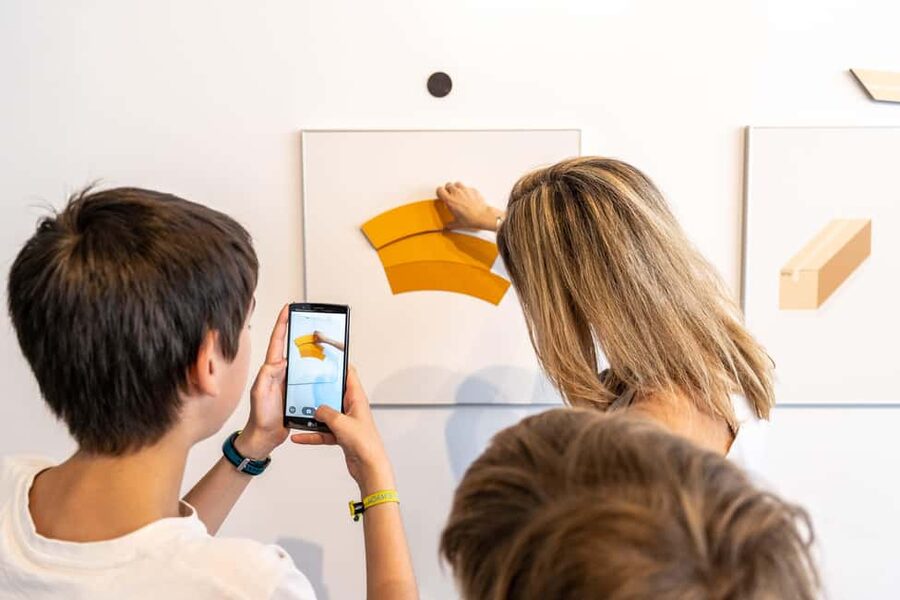
The Museum of Illusions Amsterdam sits in the former Nieuwe Waalse Kerk on Keizersgracht, one of the city’s classic canal streets. That matters more than you might think: you get the fun “Amsterdam walk-up” vibe right at the start, with a historic façade and museum signage that helps you find it without stress.
If you’re planning a day of sightseeing, this is a good slot because it works well as a standalone activity or a break between canal wandering and a museum crawl. And because the ticket experience is built around a short time window, you’re not committing a half-day when the city’s weather decides to change its mind.
What your 1.5 hours feels like inside
This is designed as a compact experience: plan on about 1.5 hours from entry to exit. The museum’s rhythm is simple. You move through a sequence of interactive areas where each room nudges one specific skill your brain uses constantly—judging distance, staying upright, reading shapes, or interpreting depth cues.
Don’t treat it like a quiet gallery. It’s meant for movement, experimentation, and play. The “aha” comes from doing, not reading. If you lean in and actually try the prompts in each installation, your brain stops being the passive observer and starts being the star of the show.
A small group setup (limited to 5 participants) also changes the feel. You’re less likely to feel squeezed or ignored, and you can spend longer testing an illusion rather than rushing to “get through.”
The brain lessons: contrast, motion, and perspective (in plain terms)

One of the best parts of this museum is that it doesn’t just show you optical tricks. It explains the logic behind them in a way that makes you rethink everyday seeing.
Here’s what the museum emphasizes through its installations:
- Contrast: how differences in light and shading can trick your sense of edges and shape
- Motion: how your brain predicts what’s moving and how that prediction can mislead you
- Perspective: how angles and viewpoint cues can reshape what you think is “real” distance
You’ll also run into the idea that your brain doesn’t simply record the world like a camera. Instead, it fills in missing information to create a complete picture. That’s why an illusion can feel so convincing even when you know the trick should be possible.
For me, that’s the key value: you leave with a better understanding of how perception works, not just a collection of funny photos.
More gallery time in Amsterdam
Rooms that mess with space, depth, and balance

The museum’s standout effect category is the one that disrupts how you interpret physical space. You’ll encounter interactive installations built to challenge:
- Space: where you think you are vs. where you actually are
- Depth: what seems close, far, or impossible
- Balance: how easily your body follows the visual cues
These are the rooms that make you slow down, then laugh, then try again. You’re not just looking; you’re adjusting your stance, stepping carefully, and noticing how fast your sense of orientation can change when the visual input changes.
You can also expect classic crowd-pleasers tied to the museum’s theme. Expect moments like walking on walls and effects where you can make friends look smaller. Those are worth prioritizing if you’re here mainly for fun, because they deliver maximum “how is that possible” reactions per minute.
Photo-ready illusions where staff actually help you
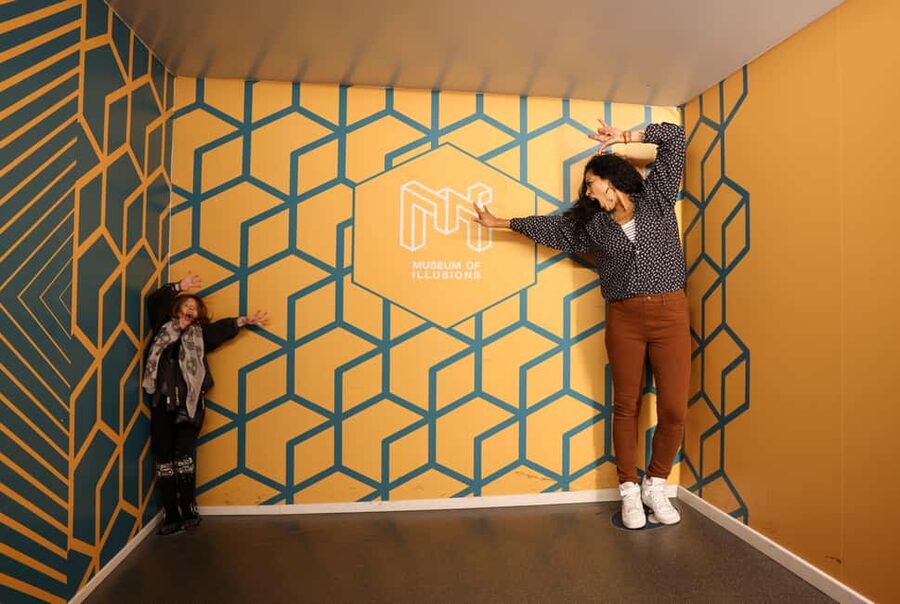
Let’s be honest: many illusion museums are photo factories. This one is that too, but it has something practical going for it—staff assistance and guidance during the experience.
That makes a difference. When you’re trying to create the right angle for camera tricks, tiny positioning choices matter. Having support means you’re more likely to get the effect on your first attempt, instead of spending your whole time hunting for the exact spot.
The museum also clearly designs rooms for pictures that look impossible. If you go with a group, you’ll often be able to stage clever shots together. If you go solo, you can still get the fun results with the guidance on where to stand and how to frame the shot for the illusion to work.
And yes, the photos are a big part of why people enjoy this place. The best strategy is to treat photos as part of the learning. Try it once for the fun, then try it again once you understand what your brain is being fooled by.
How the education part keeps it from feeling like a one-note gimmick
Some attractions trade learning for spectacle. Here, the education shows up through the explanations at each exhibit and the overall theme: your brain’s job is to make sense of the world, and illusions are proof that it doesn’t always succeed.
That’s why the museum works for different ages. Kids get the game-like feel and instant laughs. Adults tend to enjoy the “wait, that’s how my vision is tricked” moment. Either way, you leave with something you can actually talk about on the street afterward, not just a couple of blurry images.
If you’re visiting with teens or curious adults, this is one of those activities that feels like a mental workout without being boring. It’s science, but you don’t need a textbook to get it.
A quick reality check on expectations
This is a playful indoor museum, and it’s built around interactive installations. So your experience will depend on your willingness to move around, follow prompts, and accept that your eyes will lie to you.
A few practical notes based on what’s clearly part of the experience:
- Food and drinks are not allowed, so plan to eat before or after.
- The time window is short, so you’ll want to keep an eye on your pace rather than letting one room consume all your time.
- If you’re traveling with very young kids, note that children up to 4 years old enter for free, but you should still expect it to be a fun, moving environment.
Where to fit it into your Amsterdam day
Because it takes about 1.5 hours, this is easy to combine with other canal-area plans. You can use it as:
- A rainy-day fix when you still want something upbeat
- A quick mental break between larger museums
- A family-friendly activity that doesn’t require long walking circuits
The canal location also makes it convenient for pre- or post-steps. You can arrive, do the illusions, then continue your day along Keizersgracht while the city’s “wow” factor is still fresh.
Ticket value: is $23 worth it?
At $23 per person, this isn’t the cheapest thing on your Amsterdam list. But it does pack value in a few important ways:
- You get access to all interactive exhibits and installations, not just a small section
- Each exhibit includes educational information and explanations
- You get staff assistance and support throughout
- Photo opportunities are built into the experience
- You can also access the museum shop
For a short, hands-on activity, that’s a strong bundle. If you’re the type who enjoys doing things (not just watching), you’ll likely feel the cost more justified than if you prefer quiet, guided, sit-down museums.
Also, if you have small children, the free entry for kids up to 4 helps the overall family math a lot.
Should you book the Museum of Illusions Amsterdam entry ticket?
I’d book it if you want an activity that’s actually fun and has a reason behind the spectacle. This is especially good for couples, families, and groups who like interactive experiences, quick learning, and photos you can’t recreate anywhere else.
I’d hesitate only if you dislike places where you’re expected to move, pose, and experiment. Also, because there’s a note about the place being closed for at least one booking, it’s smart to confirm your time slot before you rely on it as your day’s anchor.
If you want a short, high-energy Amsterdam stop that plays fair with your curiosity, this one’s an easy yes.
FAQ
How long is the Museum of Illusions Amsterdam entry experience?
It lasts about 1.5 hours.
Where is the Museum of Illusions Amsterdam located?
It’s in the former Nieuwe Waalse Kerk on Keizersgracht in Amsterdam.
How much is the entry ticket?
The price is $23 per person.
What’s included with the entry ticket?
You get access to all interactive exhibits and installations, educational explanations at each exhibit, staff assistance, photo opportunities, and access to the museum shop (plus local taxes and fees).
Are there any age discounts or free entry for children?
Yes. Children up to 4 years old do not require a ticket and can enter for free.
Are food and drinks allowed inside?
No, food and drinks are not allowed.
What languages are offered by the host or greeter?
Dutch and English.
Is free cancellation available?
Yes. You can cancel up to 24 hours in advance for a full refund.
Can I reserve and pay later?
Yes. You can reserve your spot and pay nothing today, then pay later.
More Amsterdam Museums






More Tickets in Amsterdam





More Tour Reviews in Amsterdam




Just added: fresh Amsterdam tour reviews





Museums, compared.
 ★ 4.2Red Light Secrets Museum Entry TicketFrom $175,722 reviews
 ★ 4.5Amsterdam’s Weirdest Museum: Ripley’s Believe It or Not!From $264,920 reviews
 ★ 4.6Van Gogh Museum Ticket and City Canal CruiseFrom $473,899 reviews
 ★ 4.5Van Gogh Museum Ticket & Canal CruiseFrom $473,304 reviews
 ★ 4.4NEMO Science Museum TicketFrom $252,979 reviews
 ★ 5.0Van Gogh Museum Amsterdam Exclusive Tour w/ Reserved EntryFrom $1731,760 reviews
 ★ 4.0Moco Museum Amsterdam Admission Ticket with Banksy and moreFrom $271,745 reviews
 ★ 5.0Van Gogh Museum Tour Reserved Entry Semi PrivateFrom $1731,437 reviews
Browse the lists this tour appears in