
Reviewed · CITY TOURS
Discover the City Centre of Amsterdam
Amsterdam clicks into place fast. This small-group city-centre walk strings together canal logic, religion, and major turning points of the city, from Dam Square’s beginnings to the Jewish Quarter’s memorial. I especially like the way the guide turns each stop into a clear story you can picture, and I like the personal recommendations you get at the end for the rest of your days. One possible drawback: you’re walking outside and the route works best with good weather, plus the House on the Three Canals stop has an admission ticket that isn’t included.
You’ll move at an easy pace for about 1 hour 45 minutes, with stops kept short so you stay oriented instead of overwhelmed. The tour runs in English, uses a mobile ticket, and caps at 15 people, which keeps questions from getting lost in the crowd. My tip: treat this as your first-day “get your bearings fast” walk, not as a deep museum day.
If you like history but hate long lectures, you’ll fit right in. The best part is that the city landmarks do the teaching, from canal names and bridge views to church changes after the Protestant Reform. It’s also a smart value because many stops are free, so you’re mostly paying for the storytelling, not entry fees.
In This Review
- Key things I’d watch for
- Dam Square to the oldest canal system
- House on the Three Canals: WWII hideouts and the printing press story
- Rokin and Muntplein: water management, bells, and tulip arrival
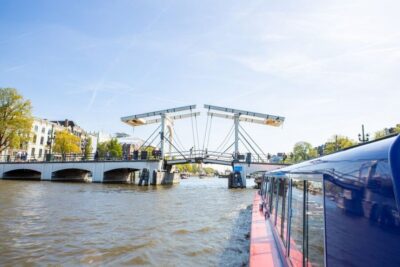
- Halvemaansbrug and Staalmeestersbrug: Amstel views and dancing houses
- Memorial Plate Jewish Amsterdam: tolerance, memory, and the final link
- Price and what you’re really paying for
- Pacing, language, and the kind of guide you’ll want
- Planning your walk: meeting point to finish in the Jewish Quarter
- Should you book this Amsterdam city-centre walk?
- FAQ
- How long is the Amsterdam City Centre tour?
- How much does the tour cost per person?
- What language is the tour offered in?
- Is a mobile ticket provided?
- Do I need to pay for any museum or monument entrances?
- Where does the tour start and where does it end?
- How big is the group?
- What if the weather is bad?
Key things I’d watch for
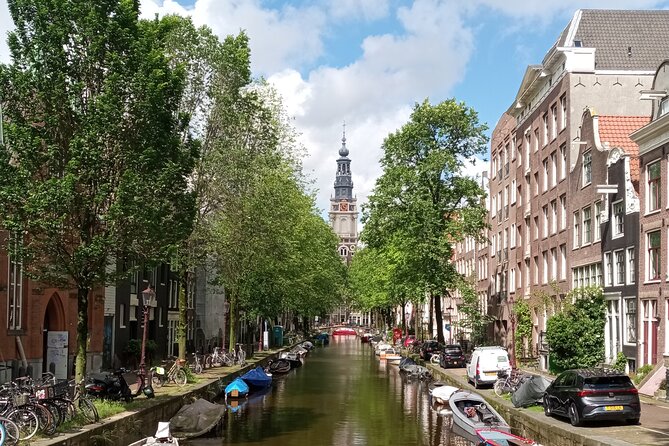
- Dam Square to Jewish Quarter, on foot: a straight route through the core with major themes repeated in the architecture and street layout.
- Short stops that actually stick: each location gets about 10 minutes, so you learn without the timeline blur.
- Canals explained in plain language: you’ll understand why the city’s waterways look the way they do and what they were for.
- WWII details at House on the Three Canals: a focused look at a hidden printing press and what people hid.
- Iconic bridge viewpoints: you get multiple photo-friendly bridge spots built into the story, including a famous view from Staalmeestersbrug.
- End-point that ties the whole walk together: you finish at a memorial plate in the Jewish Quarter, connecting tolerance to what you saw earlier.
The bigger picture: more Amsterdam city tours
- Amsterdam: 75 Minute City Canal Cruise with Audio Guide
★ 4.4 · 19,938 reviews - Amsterdam: City Centre Canal Cruise including Audioguide
★ 4.3 · 16,901 reviews - Amsterdam: Smoke and Lounge City Boat Cruise
★ 4.7 · 8,572 reviews - Amsterdam: City Card with Free Entrance & Public Transport
★ 4.3 · 4,145 reviews
Dam Square to the oldest canal system
The tour starts at Dam 39 near Dam Square, one of Amsterdam’s oldest anchor points. This is a good place to begin because the square feels central even before you know the city. The guide sets the tone with the origins of Amsterdam, then you keep moving so the “beginning” becomes a map you can follow.
From there, you head to the Oudezijds Voorburgwal area, tied to the city’s oldest canal. This stop isn’t just canal-watching. You’ll hear how the canals were laid out and why they mattered, plus what religious buildings were doing in this district. It helps you read the waterfront like a historical diagram instead of a pretty backdrop.
Next comes Oudezijds Achterburgwal, where the talk shifts to the Red Light District’s history and the culture that formed around drugs in Amsterdam. This is where you learn that Amsterdam’s story isn’t one-note. The city has always been a meeting point of rules, livelihoods, and conflict, and the canal neighborhoods reflect that.
Two practical notes here:
- Wear comfortable shoes. These are short segments between canals and bridges, but Amsterdam old streets can still feel uneven.
- Listen for canal name clues. If the guide mentions what a canal area was used for, you’ll start recognizing patterns as you walk.
House on the Three Canals: WWII hideouts and the printing press story
A highlight is the stop by the House on the Three Canals. The key point is WWII-era survival: a hidden printing press and the kind of hideouts people used during the Nazi occupation.
This works well because the building sits in the middle of normal street life. You’re not walking through a theme park “set.” You’re seeing how the past is stitched into everyday Amsterdam. It also gives you a concrete way to remember a big, grim chapter: instead of just names and dates, you get an image of what could be hidden in plain sight.
Here’s the one caution: the admission ticket for the House on the Three Canals is not included. That doesn’t mean the storytelling part is skipped. It just means you may need to decide on the spot whether you want to pay extra if you want access beyond the exterior framing.
If you’re the type who dislikes add-on costs, you can still enjoy this stop as a nearby interpretive moment. If you love architecture and clandestine details, it’s the one to consider budgeting for.
Rokin and Muntplein: water management, bells, and tulip arrival
After the WWII focus, the route pivots back to how Amsterdam works. You’ll stop at Rokin, near the narrow canal stretch where the Amstel river ends. This part connects geography to engineering, with a clear explanation of water management in the Netherlands and why it’s so important. The canals aren’t just decorations here. They’re part of a bigger system that kept the city functioning.
Then you move to Muntplein, by the flower market area and through-to-the-bridge vibe. This stop is about town walls, bells heard across the city centre, and the introduction of the tulip to the Netherlands. It’s a nice break from heavy topics because you get cultural info anchored to real street features.
I like this section because it teaches you to notice small details:
- bells that pop up across the centre,
- street layouts that hint at older town boundaries,
- and the way a single “plant story” became part of the country’s identity.
If you’re visiting in tulip season, this stop lands even better. Even outside peak bloom, it gives you the context for why the city loves the flower so much.






Halvemaansbrug and Staalmeestersbrug: Amstel views and dancing houses
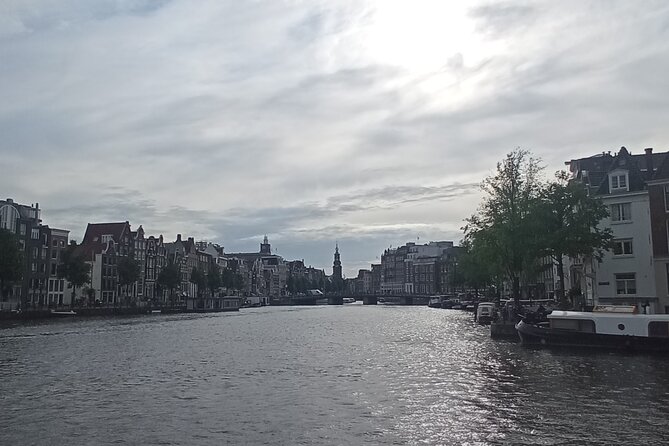
Next you cross into the Amstel river zone. At Halvemaansbrug, you get a look at house boats and the famous “dancing houses” concept that Amsterdam is known for. The guide uses the scene to explain why these structures feel like they’re doing something they shouldn’t. That visual pays off later because once you’ve seen the river-side logic, you start spotting more building oddities across the centre.
Then you reach Staalmeestersbrug, often cited as an iconic view. This is the part where the group tends to slow down and look longer, because the angle makes the city’s change over time easier to grasp. Here the story includes the Protestant Reform and what it changed about churches.
That’s a useful thread: Amsterdam didn’t just change politically. It changed in its religious spaces, and those changes show up in the way churches functioned and how their presence was felt in the city.
If your goal is photos, this is your best stretch. The view is practical for sightseeing, not just postcard framing. You can stand, read the guide’s explanation, and then look again with new context.
Memorial Plate Jewish Amsterdam: tolerance, memory, and the final link
The last stop is the Memorial Plate Jewish Amsterdam Walk at the Jewish Quarter end-point near De stem van Amsterdam on Amstel 1. The guide connects this area to Amsterdam’s Jewish history and explains how tolerance developed in the city.
I like finishing here because it changes the mood in a meaningful way. Earlier stops taught you how to read canals, walls, and bridges as clues. This finish teaches you that the same city also carries memory—sometimes quietly, sometimes intentionally.
It also gives your walk a full arc:
- origins and layout,
- religion and social reality,
- occupation and resistance,
- engineering and cultural adoption,
- then the community story and the idea of tolerance.
You leave with a clearer picture of how Amsterdam became what it is, not just what it looks like.
Price and what you’re really paying for
At $12.04 per person for about 1 hour 45 minutes, this is a strong value if you want a first-day orientation that doesn’t turn into a fee-fest. Many stops are free (Dam Square, both Oudezijds canal stops, Rokin, Muntplein, Halvemaansbrug, Staalmeestersbrug, and the memorial plate). The only clear “possible extra” is the House on the Three Canals admission.
That matters because you can control your budget. You’re not forced into museum pricing to get the core experience. You’re paying mostly for the guide’s ability to connect each location to a reason it exists.
There’s also a practical value in group size. With a maximum of 15 people, you’re more likely to get answers to your questions without waiting. And if you’re arriving on a tight schedule, a tour booked about 67 days in advance suggests this route gets popular, so plan early if your dates are fixed.
Pacing, language, and the kind of guide you’ll want
The tour runs in English, and the guide is there to answer questions. The stops are short—about 10 minutes each—so your brain stays switched on. Instead of a long walk with one lecture, you get a sequence of mini-lessons. It’s a format that works especially well for people who get tired of “talk, talk, talk.”
A guide name that has shown up for this experience is Aldo, and the vibe that comes through is energetic but not chaotic. The goal is clear: keep the walk interesting, help you understand what you’re seeing, and end with practical recommendations for what to do next.
If that sounds like your style, you’ll likely appreciate this tour’s focus on day-to-day city life. You’re not just collecting facts. You’re learning how Amsterdam pieces together so you can plan your remaining time with less guesswork.
Planning your walk: meeting point to finish in the Jewish Quarter
Meet at Dam 39, 1012 JS Amsterdam. The ending point is De stem van Amsterdam, Amstel 1, 1011 PT Amsterdam, and the tour finishes in the Jewish Quarter.
That’s a smart setup if you want to keep exploring right after. It also means you’re not retracing your steps to the start. You end closer to another big area of the centre, so your evening plans don’t have to start with a long reposition.
Because the tour depends on good weather, I’d plan to dress for changeable conditions. Bring a water bottle too; food and drinks aren’t included.
Should you book this Amsterdam city-centre walk?
Book it if you:
- want a strong first-day orientation from Dam Square into the Jewish Quarter,
- like history tied to what you can see—canals, bridges, church changes, and architecture,
- and you want local guidance at the end for where to go next.
Consider passing or pairing it with a slower plan if you:
- only want fully ticket-included sights (the House on the Three Canals admission is not included),
- hate walking in wet or windy weather (the experience requires good weather),
- or you prefer spending most of your time inside museums rather than in the streets.
For most visitors, this hits the sweet spot: a focused 1 hour 45 minutes with major themes, multiple free stops, and a guide who keeps you engaged while you learn to read the city in real time.
FAQ
How long is the Amsterdam City Centre tour?
It lasts about 1 hour 45 minutes.
How much does the tour cost per person?
The price is $12.04 per person.
What language is the tour offered in?
The tour is offered in English.
Is a mobile ticket provided?
Yes, you’ll get a mobile ticket.
Do I need to pay for any museum or monument entrances?
Entrance tickets to monuments or museums are not included. The stop by the House on the Three Canals specifically notes that admission is not included.
Where does the tour start and where does it end?
It starts at Dam 39, 1012 JS Amsterdam, and ends at De stem van Amsterdam, Amstel 1, 1011 PT Amsterdam (finishing in the Jewish Quarter).
How big is the group?
The tour has a maximum of 15 travelers.
What if the weather is bad?
The experience requires good weather. If it’s canceled due to poor weather, you’ll be offered a different date or a full refund.
Amsterdam Highlights in a Single Day



More Tour Reviews in Amsterdam






Just added: fresh Amsterdam tour reviews





City Tours, compared.
 ★ 4.475 Minute City Canal Cruise with Audio GuideFrom $1819,938 reviews
 ★ 4.3City Centre Canal Cruise including AudioguideFrom $1716,901 reviews
 ★ 4.7Smoke and Lounge City Boat CruiseFrom $278,572 reviews
 ★ 4.3City Card with Free Entrance & Public TransportFrom $794,145 reviews
 ★ 4.6Van Gogh Museum Ticket and City Canal CruiseFrom $473,899 reviews
 ★ 4.4City Canal Cruise and Heineken ExperienceFrom $443,133 reviews
 ★ 4.5City Canal Cruise and RijksmuseumFrom $472,226 reviews
 ★ 4.7Relaxed City Highlights Guided Bike TourFrom $341,069 reviews